Integrations
Payments & third-party integrations
MercadoPago QR payments, multi-country electronic invoicing, and RIS/LIS bridges — idempotency and signature verification treated as defaults.
Sanitized excerpt of commercial work on Salutte2 (Alephoo HDE). No proprietary code is disclosed.
Context
An EMR product expanding into new payment flows and external systems. Each integration needed to be reliable under real-world conditions: retries, duplicate events, signature verification, and partial failures.
What I built
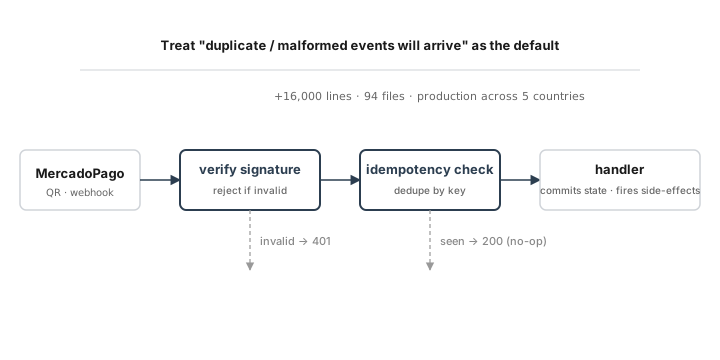
- MercadoPago QR + webhook — a payment flow with blocking UX, webhook ingestion, idempotency, and signature verification (+16,000 lines, 94 files).
- HC → RIS integration — bridged the EMR to an external radiology system (RIS Eden) via a client + factory + controllers + tests (+7.7k/-3k lines).
- Electronic invoicing with Facturacion.Cl — enabled platform operations in Chile (a new country market).
- A reusable integration pattern (client, signature/idempotency, retry) applied across webhooks and external APIs, plus social-work/insurance coverage-validation integrations (obra-social brokers).
Decisions worth defending
- Idempotency + signature verification first. Webhooks redeliver; a missing idempotency key means double-charging or double-processing. I treat "the integration will receive duplicate/malformed events" as the default.
- Client + factory for the RIS bridge — swappable adapter so the EMR isn't hard-coupled to one radiology vendor.
Outcome
New payment capability and market expansion (Chile), plus a hardened integration layer reused by subsequent third-party connections — for a product operating across Argentina, Chile, Colombia, México, and the Dominican Republic.
Evidence (public PR metadata)
- PR #13461 — MercadoPago QR + webhook (+16k/-5k lines).
- PR #13424 — HC → RIS Eden integration (+7.7k/-3k).
- PR #13105 — Facturacion.Cl electronic invoicing.